I finally got around to reading his excerpt from "the new industrial state." There were two ideas that stuck out.
The industrial society that is characterized by high technology is dependent on demand for increased production. Organizing society in a way that allows a person to work until they have enough for the week would paralyze production. Hence, the need for advertisement and creating desire is integral to the health of our system of social organization.
I was watching the CBC show "Dragon's Den" where innovations are pitched to investors. The product was a gun scope. Two of the investors said that they would not invest because of ethical reasons. The next investor responded saying "the only ethics is profit"
This scares me. What kind of society do we live in that allows a debate about whether the only ethic that matters is greed. Since when has greed become a virtue?
I suppose it is a virtue given Galbraith's description of the industrial state that is predicated on endless accumulation and ever increasing production. To make this an ethical discussion, those terms are just fancy ways of saying greed - unsustainable greed that values turning living ecosystems into inanimate, dead consumer goods.
The second idea deals with freedom and society. The point he made was that the people that are bastions for individual freedom in society are those who often have the least. CEOs, politicians and military figures are chosen and ascend to the rank they achieve most often because of submission to discipline and conform their thinking. They are expected to live up to the highest standards.
This line of thought leads me to the link between business and social conservatives. They seem odd bedfellows to me. I think this distinction articulates the schizophrenic nature of current business-religious conservative parties. And perhaps one which is often reflective of conservatives individuals ability to compartmentalize their actions - hierarchical thinking instead of systems thinking.
A conservative has a vision of what the perfect system is and tries to remove the distortions and thus achieve utopia. For business conservatives this means free market, small government. For social conservatives, this means bringing laws in line with the moral code in the bible.
Morality in this case largely means working hard and social controls in private life. Both factions can agree on this. The blind spot is morality from 9 to 5 and indirect impacts of actions.
I think this is more reflective of American Republicanism, and I am not sure where our brand of Canadian progressive conservativism fits in. Though many of the policies enacted by the minority government have been in line with traditional conservative ideology (tax cuts, program cuts..ie. funding constitutional challenges, getting tough on crime...marijuana). But there are a lot of disillusioned liberals that went conservative in the last election. So what does a right of centre liberal look like?
Anyway... liberal thinks about what are the impacts of my action - looking for implications/ cause and effect. - pragmatically progressing toward "the best we can do" as opposed to a utopia (which often gets people killed in the name of ideology). I think that is what it can be at its best anyway. It probably isn't that reflective of the party.
Tuesday, October 30, 2007

Saturday, October 06, 2007
Defining Emergent
What is the emerging church?
I think it comes down to a single element. How is the concept of certainty defined?
About four years ago I went through a struggle with defining certainty. I grew up believing that certainty was knowing the right answer and providing that answer when in dialogue (Paul: always be prepared to give an answer). This conception was based on maintaining a systematic theology that explained everything. Learning was directed at filling in the gaps. The gaps are not examples taken from reality and experience but from the Bible. My world view had to account for and not be contradicted by any verse in the Bible. Experience and reality were seen through the lens of biblical verses. If there were gaps between experience and the Bible, then it was explained as something that we could not know. ie. ultimate authority was through scripture.
Well after a while the experiences that had unsatisfactory answers and were pushed to the back burner began to leave a nagging feeling. Things didn't add up. This was also the time that I changed my definition of certainty. It went from being able to provide an answer and having faith in the link from my certain world view (theology) to reality to exposing my faith and world view to question and the test of reality. The argument goes that if I am certain about my theology then it doesn't need me to shield it from the test of reality and exposure to legitimate questions that reality and experience expose it to.
As John Douglas Hall points out in The Cross in Our Context, this is the difference between theology and ideology. Ideology is not only found in religion, but also in politics and many other ways of seeing the world.
Does the paradigm or world view shelter thinking from reality or does it offer the opportunity to think through the implications of experience to world view.
This is the test to determine an emergent church from repackaged church.
I think it comes down to a single element. How is the concept of certainty defined?
About four years ago I went through a struggle with defining certainty. I grew up believing that certainty was knowing the right answer and providing that answer when in dialogue (Paul: always be prepared to give an answer). This conception was based on maintaining a systematic theology that explained everything. Learning was directed at filling in the gaps. The gaps are not examples taken from reality and experience but from the Bible. My world view had to account for and not be contradicted by any verse in the Bible. Experience and reality were seen through the lens of biblical verses. If there were gaps between experience and the Bible, then it was explained as something that we could not know. ie. ultimate authority was through scripture.
Well after a while the experiences that had unsatisfactory answers and were pushed to the back burner began to leave a nagging feeling. Things didn't add up. This was also the time that I changed my definition of certainty. It went from being able to provide an answer and having faith in the link from my certain world view (theology) to reality to exposing my faith and world view to question and the test of reality. The argument goes that if I am certain about my theology then it doesn't need me to shield it from the test of reality and exposure to legitimate questions that reality and experience expose it to.
As John Douglas Hall points out in The Cross in Our Context, this is the difference between theology and ideology. Ideology is not only found in religion, but also in politics and many other ways of seeing the world.
Does the paradigm or world view shelter thinking from reality or does it offer the opportunity to think through the implications of experience to world view.
This is the test to determine an emergent church from repackaged church.
Sunday, July 29, 2007
Vancouver
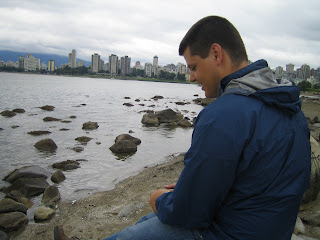
 This is my attempt at trying to figure out how to put a picture on my blogger profile, something I should have done a year ago
This is from a week ago, we visited Vancouver for a friend's weddin and took a picture at Kits beach, looking accross Burard Inlet (which has been in the news this week for a big oil spill) at West Vancouver.

Thursday, July 19, 2007
Conservatives caught in a lie
Yesterday City Council debated secondary suites. The two sides of the debate are: 1. affordable housing; 2. property rights (buyers buy in a neighbourhood on the basis that it will stay the same - ie. noise and traffic levels, but secondary suites increase density - read noise and traffic).
I sat in on a Council meeting a couple weeks ago and there was a discussion about converting rental stock to condominiums. Council was seeking the power from the province to be able to regulate this practice. Basically, someone buys a rental building, kicks all of the people out, then sells the apartments individually and makes a huge profit.
Ald. Ric McIver (very conservative) opposed the motion saying that he would not interfere with people's right to dispose of their property as they see fit.
This is the same argument against rent control.
So my argument is that if they aren't going to use rent control, or stop condo conversions on the argument that government should not interfere with my right to dispose of my property as I see fit (which is a bull shit in the first place - see what happens when I have a horse stabled in my apartment). Then they should apply the same argument to secondary suites.
What this hypocrisy tells me is that Conservatives hate lower middle class people. They use whatever argument is available and convenient to protect property value and my ability to make money off poor people.
I sat in on a Council meeting a couple weeks ago and there was a discussion about converting rental stock to condominiums. Council was seeking the power from the province to be able to regulate this practice. Basically, someone buys a rental building, kicks all of the people out, then sells the apartments individually and makes a huge profit.
Ald. Ric McIver (very conservative) opposed the motion saying that he would not interfere with people's right to dispose of their property as they see fit.
This is the same argument against rent control.
So my argument is that if they aren't going to use rent control, or stop condo conversions on the argument that government should not interfere with my right to dispose of my property as I see fit (which is a bull shit in the first place - see what happens when I have a horse stabled in my apartment). Then they should apply the same argument to secondary suites.
What this hypocrisy tells me is that Conservatives hate lower middle class people. They use whatever argument is available and convenient to protect property value and my ability to make money off poor people.
Sunday, July 15, 2007
Friere and the problem of power in helping people
Friere (1970) Pedagogy of the Oppressed
Action Reflection: The activist is useless without reflection – there is no conscious direction. Reflection without action is also useless, it gets nothing done. - This concept is very similar to the metaphor of a car. It can’t get to its destination if it is not moving, or if it is moving in the wrong direction. It needs direction and action to achieve a goal.
The power of definition: One of the exercises is to get people to express their situation and see it for what it is, from their own perspective, not the perspective they have been fed for so long. This argument has a lot of similarity to Said and the concept of the Oriental. It was a category that was defined from the outside, and covered diversity and fit into the worldview of colonialism/oppression. The same thing happened with the “Nobel Savage.” These categories are based on a rejection of empathy, equality, and efforts at understanding. It is the construction of an other. The other is defined by the core, uppers, insiders, and is what matters. The periphery, lowers, outsiders, the other, are defined as what is on the other side of the boundary that creates the category of insider. In the case of colonialism, it was European / non-European. I personally never learned of a country that named itself non-European. This is a given identity. Rejecting this given identity for a self-defined identity is a process that rejects the status that is given, and empowers people to be equal, because each has a unique history, both are people, and each story is of equal value. African history is not a chapter in the book of European history. They are all sections in Human history.
The oppressed have to shake off oppression for the sake of the oppressors as well as themselves. Oppressing kills the humanity in people. It is a bondage that the oppressor can rarely shake off themselves. What does it mean to us in Canada to be the oppressor? It isn’t a common identity characteristic I take for myself, being in the development studies program and devoting my life to the poor. But there is something there. I enjoy my university degree and the prestige, and the moral superiority of the concern for the poor, and the standard of living I am able to maintain (because of little hands) because of my education. I have two lives. I go to work and spend that life working for the betterment of those suffering in poverty, then I go home to my Ikea condo. And I’ll be damned if I don’t feel cheated when an engineer makes more money than me with less education and experience.
Well, I did choose to work for the cause of poverty. I am not willing not to work on the cause of poverty. Within that qualification, I would like to get ahead as much as the next person. I would also like to do this ethically, not fighting against myself and with my consumption habits. But the wonders of global capitalism make it possible for me to not know the conditions in which my consumer goods were made.
I am losing track of where I was going. Solidarity with the poor v. being the oppressor. Is it possible to do both at the same time?
I think so, I do it at work and at home. I am an oppressor vis a vis the genetic lottery that gave me good health care, almost free education, cheap consumer goods. But I am also in solidarity with the poor because that is my existential identity.
When I evaluate my life I ask: What have you done for the poor today? I don’t ask how much money I made. Or if I have the approval of my superiors.
Here is another interesting thought I have been mulling over. I am part of something larger than myself (fighting poverty, injustice and death). The poor have one responsibility, take care of themselves, so I (social agencies) don’t have to, and so they can contribute instead of cost they system money. Within the social safety net is a built in hatred for the poor, mind you, it is also a love, because without the poor, my life would be meaningless (Kierkegaard, Fear and Trembling).
But, I don’t focus on caring for myself (the advice so often given out to homeless people). I focus on this larger thing that I am a part of and I find my identity in. If I just had to take care of myself, what’s the point? Why get out of bed in the morning?
I think a good way of summarizing this idea is the Nihilistic gospel of the Social Safety Net.
Once again, I think this gets back to Friere’s point on the power of definition (identity construction). If the poor are given the chance to define themselves (instead of being classified as homeless, or poor), and each individual finds their story, and the explanation of why they are homeless, what they are struggling and succeeding with, then perhaps appropriate solutions can be found. They will have a clear picture of what large social forces they are a part of. Instead of accepting the identity of loser, down and outer, addict, homeless, and all the power relations that are associated with those titles. Maybe these people can find their identity in their story, their history, and be equal human beings with the rest of “normal” society.
So what is a more appropriate gospel for the Social Safety Net? One that focuses on story telling, and recognizes the individuality of people (v. the faceless herding of the current shelter system). This may be the Housing First principle manifest in the Thames reach organization. The organization sends taxis out to go find “rough” sleepers – people sleeping outside, and offers them an apartment, then they are offered what ever resources they need, counselling, job training, etc.
But this project of identity creation is also grounded in an existentialist understanding of people’s responsibility; not blaming social forces, but recognizing their role in the same time.
Karl Polanyi argues that the problem with capitalism is that no one is ultimately responsible. Unemployment (homelessness) is the fault of the “invisible hand.” Perhaps the movement of existentialism is in reaction to the invisible hand. Which are the rules that everyone agrees to play by, but seemingly, no one established. My Marxist friend describes this situation as the problem of liberalism – you can see the problem, but are powerless to change anything.
This gets back to my dualistic life as a good liberal. I work against oppression and to improve the plight of the poor during the day. Then at night I consume and live the life of a “normal” (in the sense of the power of definition) middle class citizen (v. non-citizen, ie. homeless person). The steps in the value added chain separate me from assuming responsibility. What is the existential cost of this distance, of disempowerment? I can not change my situation, so I can not make decisions, so, I can not create who I am.
Kierkegaard talks about the anxiety of possibility – the possibilities of who I can be, then the anxiety of being that person, asking what if.
Am I able to create my identity and make decisions to the extent that I do not depend on the material comforts of western life? Does my soft bed and the indoors keep me from being who I am?
But, I suppose choosing the comforts of life over solidarity with the poor is an identity choice and I become that choice.
Can a choice be made without Sarte’s Anguish, Forlornness, and Despair? Maybe that was an existential choice. I have put those elements into the choice to serve the poor with my life. But is the situation of comfort getting in the way of the implementation of that choice? Or is the implementation the choice?
This is the split between who I am and how I live. It is hypocrisy.
On the other hand, I see my role one of empowerment. Gaining a position of authority and being an insider, upper who can disempower myself, and pass that power onto the communities I will work with; creating capacity and resiliency to deal with future problems.
I suppose mine is a slippery slope, ensuring that the identity of who I am is defined by what I do for the poor, not the comforts I have, and the selfish personal choices I am bound to face. Because the more I choose comfort the more I will find my identity in comfort instead of solidarity with the poor.
Right, the Anguish, Forlornness and Despair are qualifications for making an authentic choice. So the more I go through, the more authentic I will be.
There is a similar Christian idea, God has a plan for your life, and if you follow this plan you will be happy, if you don’t you won’t be happy.
Both of these correspond to my situation because solidarity with the poor is an authentic choice for me. But, comfort is something that I slide into unconsciously. I do not go through AFD, and therefore, it is not an authentic life.
Here is my fundamental question, what is the point of getting up in the morning if you aren’t working toward the betterment of other people? I guess a lot of people have their families.
Is responsibility for other people the only reason for living?
And, what are the power relations in this situation? I am dependent on those people needing me, and I am more powerful than those I am responsible for. They do not have responsibility for themselves because I have it. I am in control of the people I am responsible for. And this is my reason for getting up in the morning.
I sound like a sadistic prison guard.
Is social services a sadistic prison?
Oh, the complexity of altruistic existential exploitation.
The ironic part is that maybe I need to be part of something larger (fighting poverty) because I haven’t faced my own mortality, finitude. Am I comfortable with my finitude; can I find a point within myself for getting out of bed in the morning?
Without poor people I would be nothing, I would have no identity. This doesn’t scare me though, it is the goal of my life. Because then I can dissipate into infinitude. This is a nonsensical way of saying that I would be alright with not having an identity if there were no poor people. I could live for myself. – I say this because when I do enjoy material possessions, the guilt is that everyone can’t enjoy them. I am separated from the rest of humanity by my access. I don’t want to be separated by winning. I want to be completely ordinary, have my life not stand out in any way. What I mean is that I would love to live in a world where there was no haves and have nots. And if I do live in a world with haves and have nots, then I want to be in the latter group. My hypocrisy is that I am in the former group.
PAR and Pragmatism
My Recent Questions:
Q: How do I do development?
A: Ask people what they need/ figure it out with them, then do it/get it. Sophistication is added in the method/worldview of Participatory Action Research.
Q: How do I do Participatory Action Research?
A: Research is a subjective exercise (no matter what ideas of objectivity conventional social sciences delude themselves with). The outsider brings an outside perspective (free from local political correctness, etc.) and offers knowledge of research methods and facilitation to the insiders. The insiders have local knowledge and complex understandings of their own situation/context. The two, insiders and outsider, can define a research agenda and carry it out together.
Q: I need a stronger foundation in pragmatism/post modern (feminist) critique of objective, positivist science.
A: Gadamer (1975) Truth and Method – From Phenomenology to pragmatism
Diggins (1994) The promise of Pragmatism, and
Rorty (1979) Philosophy and the mirror of nature
Thursday, June 07, 2007
Transit Pricing
The following post is my analysis of the user fee for transit
I am arguing for a greater spread between the cost of using a monthly pass and single fares.
so like myth busters:
Warning Accounting content!
Facts:
a month transit pass is in Calgary, Alberta is $75.00
one fare is $2.25
So if you take 33 trips (75/2.25) in a month you break even.
if you take transit to work or school 2 trips a day * 5 days = 10 trips a week * 4 weeks = 40 trips
it would cost $90 to pay for individual fares, and you could save $15 dollar per month by buying a month transit pass.
Accounting Principles:
Marginal cost: this is a cost that increases with the quantity (materials, one fare)
fixed cost: this is a cost that remains the same and does not depend on quantity (also called sunk cost) an example is capital investments (the factory, the transit pass)
People will use transit more often if they have a monthly pass because there is no cost increase associated with taking one more trip if a person has a monthly pass.
note: this is great for the transit system because most "extra trips" are made during low demand times, utilizing unused capacity that has to be around anyway (a sunk/fixed cost). The benefit of this is that one less car is on the road.
But, people won't take that extra trip if they are using buss passes because it will increase the cost (marginal cost) of transit, so they will drive or get a ride, maybe driving beside the buss looking at their extra seat.
Now multiply that by the number of people that use single fares instead of a monthly pass and then think about the extra road maintenance and traffic. It just is not an efficient way of transporting people.
That is why I am arguing for a greater spread between the cost of using a monthly pass and single fares.
I am arguing for a greater spread between the cost of using a monthly pass and single fares.
so like myth busters:
Warning Accounting content!
Facts:
a month transit pass is in Calgary, Alberta is $75.00
one fare is $2.25
So if you take 33 trips (75/2.25) in a month you break even.
if you take transit to work or school 2 trips a day * 5 days = 10 trips a week * 4 weeks = 40 trips
it would cost $90 to pay for individual fares, and you could save $15 dollar per month by buying a month transit pass.
Accounting Principles:
Marginal cost: this is a cost that increases with the quantity (materials, one fare)
fixed cost: this is a cost that remains the same and does not depend on quantity (also called sunk cost) an example is capital investments (the factory, the transit pass)
People will use transit more often if they have a monthly pass because there is no cost increase associated with taking one more trip if a person has a monthly pass.
note: this is great for the transit system because most "extra trips" are made during low demand times, utilizing unused capacity that has to be around anyway (a sunk/fixed cost). The benefit of this is that one less car is on the road.
But, people won't take that extra trip if they are using buss passes because it will increase the cost (marginal cost) of transit, so they will drive or get a ride, maybe driving beside the buss looking at their extra seat.
Now multiply that by the number of people that use single fares instead of a monthly pass and then think about the extra road maintenance and traffic. It just is not an efficient way of transporting people.
That is why I am arguing for a greater spread between the cost of using a monthly pass and single fares.
Subscribe to:
Posts (Atom)